Find Support

Stroke Survivor Fund

Stroke Survivor Fund

The Stroke Foundation provides support for stroke survivors experiencing financial hardship to help cover the cost of physical, occupational, or speech, or other elegible rehabilitative outpatient therapies.

What is it?

What is the 
Stroke Survivor Fund?

The Stroke Survivor Fund is a dedicated financial assistance program that helps stroke survivors and their families access essential outpatient therapeutic care during the recovery journey. Many individuals face financial barriers to receiving consistent therapy, especially when costs are not fully covered by insurance or other programs.

This fund provides direct support for key rehabilitation services, including physical therapy, occupational therapy, speech therapy, vision therapy, and music therapy—all of which play a critical role in stroke recovery.

Focused on equity and accessibility, the Stroke Survivor Fund prioritizes individuals from underserved communities and those with limited financial means. By removing financial barriers to care, the fund helps survivors regain independence, rebuild their skills, and improve their long-term quality of life.

What the Fund Covers

What We Cover — 
So You Can Recover

The Stroke Survivor Fund provides financial support for outpatient therapies that promote healing, independence, and quality of life after stroke. Each therapy plays a vital role in different aspects of recovery.
Physical
Therapy
Helps stroke survivors improve mobility, balance, and strength to regain independence in daily activities.
Occupational Therapy
Focuses on restoring the ability to perform everyday tasks like dressing, eating, or personal care.
Speech
Therapy
Supports recovery of communication skills and swallowing function, often impacted by stroke.
Vision
Therapy
Addresses visual impairments caused by stroke, helping survivors adapt and restore visual processing.
Music
Therapy
Uses rhythm, melody, and musical exercises to support cognitive, emotional, and physical healing.
Eligibility 
Requirements 
for Support
  • Be a stroke survivor that resides in the United States; and
  • Demonstrate need for financial support for outpatient rehabilitation therapies; and
  • Be uninsured; or
  • Have insurance that doesn't cover outpatient therapy, or have used all outpatient therapy benefits.

How the Process Works

Step-By-Step Guide To Applying For Support

Navigating recovery is already challenging — getting support shouldn’t be. That’s why we’ve made the Stroke Survivor Fund application process as clear and compassionate as possible. Here's how it works, step by step:
1
Check Eligibility
Before applying, review the eligibility criteria above to ensure you or your loved one qualifies. The fund cannot pay for inpatient rehabilitation, durable medical equipment, living expenses, or insurance costs.
2
Complete the Application
Fill out our simple online application form. You’ll be asked to provide basic personal details, proof of stroke diagnosis, and proof of financial need. If you have insurance, you’ll also need to upload documentation showing denial of coverage or lack of applicable benefits.
3
Submit Supporting Documents
To learn about the documents we accept, read this guide. Upload your documents directly within the application, and make sure everything is legible and not blurry.
4
Application Review
Our team carefully reviews each submission to ensure fairness and accuracy. You may be contacted for clarification if needed. Processing times may vary, but we aim to provide timely updates.
5
Receive Funding Decision
If approved, you’ll receive a funding decision with next steps.
6
Start Using Your Support
If approved, use your grant toward elegible outpatient therapy. Grant funds are paid directly to the approved therapy provider.

Apply for Support Today

Get the financial assistance you need to aid your stroke recovery journey.

FAQs

You’re Not Alone in Stroke Recovery

We’ve answered the questions that stroke survivors, caregivers, and families ask most —including how to apply, what’s covered, and who’s eligible for support.
How do I apply to the Stroke Survivor Fund?

Complete our online application and upload the required supporting documents. Every application requires proof of stroke diagnosis and proof of financial need. If the stroke survivor has insurance, documentation showing that outpatient therapy benefits have run out or that the outpatient therapy is not covered may also be required. You will not be able to complete the application without submitting the documents. Applications are reviewed on an individual basis, and the timeline for each application may be different. Even if you meet all requirements and submit all documentation, we depend on the funding available to give grants. We appreciate your patience and understanding as we may take a bit of time to respond. If you have any questions, please email survivorfund@thestrokefoundation.org.

Who can apply to the Stroke Survivor Fund?

Stroke survivors living in the United States who demonstrate financial need and need help paying for eligible outpatient therapy may apply. The stroke survivor must either have no health insurance, have used all available outpatient therapy benefits, or have insurance that does not cover the outpatient therapy they need. If the stroke survivor cannot complete the application themselves, a family member, caregiver, or medical professional may apply on their behalf.

Will every applicant receive a grant?

Although we would love to be able to support all applicants, our Selection Committee reviews applications on a case-by-case basis and determine the amount granted on an individual basis to ensure we are making the greatest impact for stroke recovery. Even if you meet all requirements and submit all documentation, we depend on the funding available to give grants.

How many times can I apply?

You may apply once every six months and may receive Survivor Fund assistance up to two times. If you have already received a grant, a second application cannot be reviewed or approved until the first grant has been fully paid out.

How are funds paid out?

The Stroke Foundation pays the approved therapy provider directly after eligible services are provided. Providers may submit invoices as services are provided and do not need to wait until the full grant has been used. Grant funds cannot be paid directly to the stroke survivor or caregiver.

Can I get funds to help with my living expenses?

No. Survivor Fund grants can only be used for approved outpatient therapy. We cannot help pay for living expenses, medical equipment, other medical bills, insurance premiums, deductibles, copayments, coinsurance, inpatient rehabilitation, skilled nursing facility care, hospital stays, or home health therapy. Grant funds are paid directly to the approved therapy provider.

Will the grant cover my entire therapy?

Due to the significant cost of therapies in the United States, it is unlikely that the Survivor Fund Grant will cover your entire therapy plan. The Stroke Foundation looks at each application on a case-by-case basis and reserves the right to determine the amount of the grant for each application.

Can The Stroke Foundation help me find a physical/occupational/speech therapist?

No, The Stroke Foundation cannot recommend or advise on the medical facility imparting the therapy, the course of therapy recommended, or anything related to the medical treatment of a patient. Applicants are responsible for choosing an appropriate licensed outpatient therapy provider.

How can I support the Stroke Survivor Fund?

To support our mission of helping stroke survivors with recovery, click here to donate — every dollar counts. We really appreciate all the support we can get.

What is the Stroke Survivor Fund Program?

The Stroke Survivor Fund provides financial assistance to stroke survivors needing outpatient rehabilitation therapies at self-pay rates. We pay therapy providers directly after receiving an invoice. We require that invoices are sent to us after services are rendered.

How will I know a patient has been approved for a grant?

The patient or caregiver will provide a Letter of Commitment from The Stroke Foundation confirming the approved grant amount and use-by date. They will also receive a Provider Grant & Payment Guide explaining provider requirements, payment setup, and invoicing.

What information must be included on the invoice?

To process payment, invoices must include: - Patient’s full name and date of birth - Type of service/session provided (e.g., PT, OT, ST) - Number of sessions billed - Cost per session (self-pay rates only — no insurance billing rates) - Total amount due (not exceeding the grant amount) - Instructions for payment (bank details for ACH transfer, web portal link, or Zelle)

Do you reimburse insurance-billed sessions?

No. We only accept self-pay rates. We are not a payor and cannot accept insurance rates, EOBs, or related documentation.

How do I submit an invoice for payment?

Once you receive the Letter of Commitment and complete services, submit the invoice directly to the email address provided in the letter. Invoices must meet the above requirements. You may invoice us as services are provided. You do not need to wait until the patient has used the full grant.

How quickly do you pay after receiving an invoice?

We strive to process payments promptly once a complete and correct invoice is received, typically within 14 business days.

What if the cost of services exceeds the grant amount?

The grant amount is the maximum The Stroke Foundation will pay. Any costs beyond that are the responsibility of the patient unless other arrangements are made directly with them.

Can we offer discounted or reduced self-pay rates for Stroke Foundation recipients?

We welcome and appreciate any efforts to offer reduced self-pay rates to stroke survivors. However, it is not a requirement for participation.

Who do I contact if I have questions about the invoice or payment?

Contact details will be provided in the Letter of Commitment. You can reach out directly to our Stroke Survivor Fund coordinator for any questions regarding invoicing or payments.

Can I send an invoice for unpaid invoices after we bill the patient’s insurance?

No. The Survivor Fund cannot pay balances remaining after insurance has been billed, including copayments, deductibles, coinsurance, or amounts left after an insurance denial. Approved services must be provided and invoiced to The Stroke Foundation at the provider’s self-pay rate.

What documentation is required before payment can be issued?

Providers must submit: - Completed Provider Payment Information Form - Current W-9 - Active NPI and Tax ID/EIN - Voided business check or bank letter if ACH is selected Payments can only be issued to the approved clinic or business. Personal bank accounts and personal Zelle profiles cannot be used.

What if our clinic requires payment upfront?

The Stroke Foundation cannot prepay for future therapy sessions. Payment is made after eligible services are provided because patients may not attend every planned visit. Please contact us before declining the grant. We are happy to speak directly with your billing or financial office about how Survivor Fund payments work.
Success Story

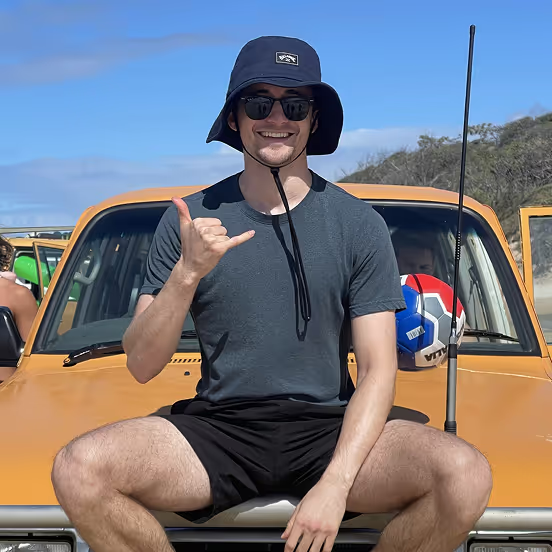
Surfing for a Cause, Inspiring Thousands

I travelled 10,000 miles and surfed across Australiato
raise funds for stroke survivors.
When we push through discomfort and do the hard things, we can go way further than we think we can!
“
Nitai was just 18 when he suffered a sudden brain hemorrhage. After months of therapy and rehabilitation, he turned his recovery journey into a mission—delivering a custom surfboard to Billabong’s headquarters and launching a week‑long fundraising challenge. His goal? To raise awareness of stroke in young people and fund critical therapy for survivors. Through his efforts, he’s inspired a community and reminded us that resilience has no limits

Your Donation in Action

Caregiver
Miderland & Frantz
The caregiving funds have been a tremendous blessing in supporting Frantz's recovery. The assistance helped cover the cost of his caregiver, allowing him to receive consistent, quality care at home while reducing some of the financial strain on our family. Because of this support, I was able to focus more on his recovery and ensure that his daily needs, medical appointments, medications, and personal care were met.
During one of the most difficult times in our lives, these funds provided hope, stability, and peace of mind, and I am deeply grateful for the difference they have made in Frantz's recovery journey.
“
Caregiver
Family of Survivor Fund Grantee
This generous support means more to us than words can fully express. It not only eases the financial burden of her recovery but also gives both of us renewed hope and motivation as we both continue to work toward regaining her strength and some form of independence. Knowing that there are people and organizations who believe in this journey is incredibly uplifting. Thank you once again for your generosity, compassion, and commitment to helping individuals like her to move forward.
We are deeply grateful for the opportunity you’ve given her to focus on healing and rebuilding her life.
“
Stroke Survivor
Amber
The Stroke Survivor Fund was there for me when I had no other resource to begin physical and speech therapy after my stroke at only age 52.
I will forever be grateful for their compassion.
“
Caregiver
Survivor Fund Grantee
“The Stroke Survivor Foundation is an amazing organization that provided us assistance when we needed it most. It allowed my husband to attend private physical therapy sessions weekly, for 90 minutes, when our insurance would not cover it. The application process was easy and stress-free.
We are so grateful to the Stroke Survivor Foundation for choosing us and we encourage any stroke survivor in need to apply.
“
Stroke Survivor
Taliza
As a 23 year old, I never thought this would be a challenge I had to face. Losing the person I was before was only a motivation to get back to that old person. I was thankful to start outpatient therapy 2 weeks after I got out of the hospital. I’m currently 6 months in & can walk, but also starting to learn how to run again like before. I told myself i’d never ever give up until i’m back to doing the things I love, and I stand by it. I’m not 100% yet, but am setting goals for the next 6 months.
Don’t give up or limit yourself on anything. It’s possible to come back from this tragic event. There will be fails, and that’s okay !
“
Stroke Survivor
Hazel
“I had a cerebellar stroke at 42yo, that affected my ability to walk. With the grant received from The Stroke Foundation I was able to get more physical therapy at a innovative clinic where the therapists are working with me in intensive sessions to help me learn to walk again.
It's motivating me and giving me hope to do things I never thought I could do again!
“
Stroke Survivor
Benjamin
“After having a stroke in 2022, I have been doing therapy in various places to regain mobility and speech. Having the opportunity to work with the team at UCF and their aphasia program was great, and then to find out that the application for assistance with the funding from the Stroke Survivor Fund for the program was successful,
felt like receiving a warm hug!
“

Every Act of Kindness Brings Someone Closer to Recovery After Stroke

Whether you give, share, or volunteer—your action fuels real stories of healing and strength.
‍
90% of donations directly help stroke survivors and their caregivers.